
Breaking down the limbic system for better mental health (Part 1).
Understanding our survival software for managing anxiety disorders, panic disorders and PTSD better.

It’s George.
The neocortex that gives us the ability for complex reasoning, planning, language formation, and so on is the most "recent" addition to our brains in evolutionary terms.
It’s what allowed us to stop reacting to the environment like a lizard and start predicting and controlling it.
This cortex builds on top of the limbic system rather than replacing it, since we can survive with a strong limbic system and minimal cortex (as reptiles do for example), but not the reverse.
Even though combining the neocortex with the limbic system creates the ultimate survival software, advanced cognition without emotional/motivational drive is useless for survival.
Without systems that:
Detect threats and opportunities
Form memories of what is dangerous or beneficial
Regulate basic drives (hunger, thirst, temperature, sex etc)
Coordinate emotional responses with bodily actions (fight, flight, freeze, or approach)
Link senses (sounds, smells etc) to rapid behavioral decisions
we would have gone extinct a long time ago.
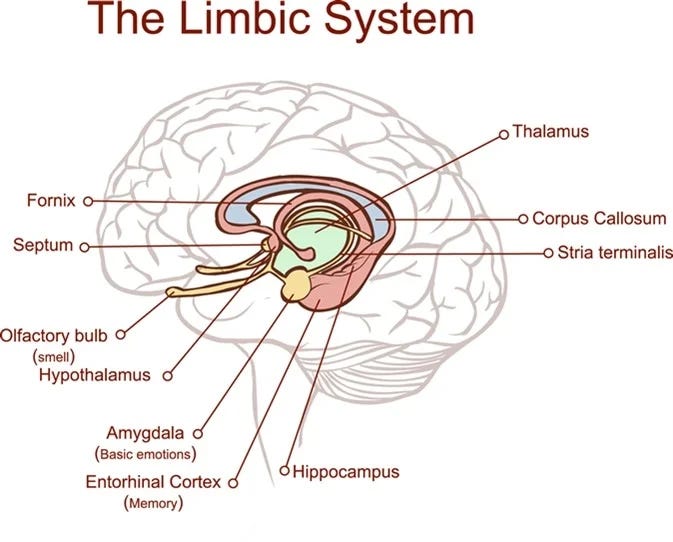
Now the limbic system consists of the following interconnected cortical and subcortical structures located primarily on the medial (inner) surfaces of the cerebral hemispheres, surrounding the thalamus, that work together through various circuits:
Amygdala.
This is a small, almond-shaped (*) cluster of nuclei located in the medial temporal lobe, just anterior to the hippocampus (if you have no idea what these are, read the previous articles: https://healthlibrary.substack.com/archive), roughly ~1.5–2 cm long.
(*)Hence the name, from the Greek amygdalon = almond.
The amygdala is not a single uniform structure but a complex of about 13 interconnected nuclei, traditionally grouped into three main complexes:
Basolateral complex (the largest part)
Includes the lateral, basal, and accessory basal nuclei.
This is the sensory gateway of the amygdala.
It receives highly processed information from all sensory cortices (vision, hearing, touch, smell, taste), the thalamus and the prefrontal cortex.
It is critical for emotional learning, especially fear conditioning (Pavlovian learning being a classic example: pairing a neutral stimulus like a tone with a shock).
Central Nucleus (CeA)
This one is the main output station.
It projects to the hypothalamus, brainstem autonomic centers (periaqueductal gray, locus coeruleus, etc.), and the bed nucleus of the stria terminalis.
When activated, it triggers the full physiological fear/anxiety response: increased heart rate, cortisol release, freezing behavior, startle reflex, etc.
Corticomedial group (including the medial nucleus)
This one is more involved in olfactory processing and social/sexual behaviors.
It has strong connections with the olfactory bulb and hypothalamus.
There are also smaller nuclei (intercalated cell masses) that act as inhibitory “gates” between the basolateral and central parts, helping regulate emotional intensity.
So its (amygdala’s) primary functions include:
Rapid emotional evaluation
The amygdala acts like an “emotional sentinel.”
It can detect potential threats in as little as 100–150 milliseconds (even faster than conscious awareness).
It assigns emotional valence (good/bad, safe/dangerous) to incoming stimuli.
Fear, anxiety, anger & aggression
It is especially tuned to negative emotions and threat detection (think anything from snakes and spiders to angry faces or sudden movements).
However, it also processes positive emotions such as pleasure from rewards and social bonding.
Fear conditioning and emotional memory
The amygdala is essential for learning that a previously neutral stimulus predicts danger.
Emotional events are remembered much more vividly because the amygdala modulates the hippocampus and releases stress hormones that “stamp” the memory.
Social cognition:
-Reading facial expressions (especially fear and anger)
-Judging trustworthiness
-Detecting social threats
-Processing gaze direction and personal space
Modulation of other brain systems
The amygdala influences attention (makes emotionally relevant things stand out), decision-making, and even pain perception (it amplifies the unpleasantness of pain).
And as it was partly stated, it receives inputs from the sensory thalamus (fast, crude route), the sensory cortices (slow, detailed route), the hippocampus (context) and the prefrontal cortex (top-down regulation).
And outputs from the hypothalamus (HPA axis & autonomic activation), brainstem (fight-or-flight), prefrontal areas (for regulation), hippocampus (memory enhancement), and nucleus accumbens (reward).
Overactivity / Hyper-reactivity is strongly linked to anxiety disorders, PTSD, phobias, and generalized fearfulness.
In PTSD, the amygdala often shows exaggerated responses and poor regulation by the prefrontal cortex.
The amygdala becomes hypersensitive, it fires strongly to even mildly threatening, ambiguous, or previously neutral stimuli.
This leads to exaggerated fear, anxiety, and emotional arousal responses.
At the same time, the prefrontal cortex (PFC), especially the medial and ventromedial PFC and the anterior cingulate cortex, fails to adequately inhibit or regulate the amygdala.
This is often described as impaired top-down control.
The result of this is a brain that stays in a chronic “high-alert” state, even when no real danger exists.
Here’s what happens in PTSD in a nutshell:
Hyperactivation of the amygdala when exposed to trauma reminders, general threat cues, or even neutral faces/sounds.
Hypoactivation (reduced activity) in the prefrontal cortex and often the hippocampus.
Poor connectivity between PFC and amygdala → the “brakes” on fear don’t work well.
So we have:
Hypervigilance
Exaggerated startle response
Flashbacks and intrusive memories
Emotional numbing or dissociation (sometimes as a secondary shutdown response)
Here’s what happens in anxiety disorders (GAD, panic disorder, social anxiety) in a nutshell:
The amygdala overresponds to uncertain or potentially threatening situations.
In generalized anxiety, it may react strongly to ambiguous stimuli (”better safe than sorry” bias).
In phobias, the amygdala lights up intensely to the specific feared object/situation (spiders, heights, public speaking etc).
The amygdala tags the stimulus as highly salient and dangerous, and the weak PFC regulation makes it hard to “unlearn.”
So in PTSD and anxiety, there’s often enhanced BLA → CeA signaling, with reduced inhibition, leading to amplified outputs.
This is of course only one trait and other neurochemical imbalances also come into play such as:
Norepinephrine and cortisol: Chronic stress sensitizes the system, amplifying responses via glucocorticoid receptors.
Dopamine: Dysregulated input from VTA strengthens emotional tagging and motivation toward avoidance.
Glutamate excess / GABA deficit: Tips the balance toward excitation.
Neuropeptides such asCRH further promote anxiety-like states in the CeA.
Now, a fair question to ask is why does this happen?
Well here’s the 101: